

We let an AI tool loose on our own brand… and here’s what happened.
We recently trialled Blaze AI - a marketing content tool that promises to generate social posts, images, and more with minimal effort. We used ourselves as the guinea pig and here’s how that worked out.

Blaze’s AI re-interpretation of our team and office space.
Summary
The Impressive: Fast onboarding, intuitive setup and easy multi-platform scheduling. We were generating content within about 30 minutes.
The So-so: Short-form copy was usable, but generic. Most outputs felt repetitive and lacking personality.
The Disappointing: Long-form content lacked depth, nuance and industry understanding. Crucially, it still required fact-checking by someone who knows the industry. The image generation also struggled badly replacing real people, technical environments and accuracy.
Our Review
Getting Started
Score: 5/5
This was genuinely one of the strongest parts of the platform.
Blaze quickly scans your website to build an initial Brand Kit, including visuals, tone and messaging style. From there, you can refine your audience, brand voice, and goals before uploading additional content like blogs, press releases and marketing materials to further train the AI.
The entire setup process was fast, intuitive and surprisingly frictionless. Within about 30 minutes, we were generating and scheduling content across multiple platforms.
For busy marketing teams wanting a centralised workflow, this part felt polished and well thought out.
Branding
Score: 3/5
The visual style matched our branding well. Layouts were clean, colour palettes were consistent and the platform did a decent job of recognising the overall look and feel of our brand.
However, there’s still a significant gap between recognising a visual brand and understanding a company’s actual communication style.
For more technical industries, communication often relies heavily on context, audience understanding and nuance.
Blaze could imitate the shape of our content, but not necessarily the thinking behind it.

Looks great… just don’t look closer.
Copy Generation
This was ultimately the area we were most interested in testing. Blaze positions itself as a tool that can help businesses rapidly create everything from quick social captions through to more substantial thought leadership and marketing content.
The results, however, varied dramatically depending on the format.
Short form
Score: 3/5
Short-form copy was… usable.
A lot of the content was forgettable: Polished and "safe" but lacking personality and originality.
For quick LinkedIn captions, filler social posts, or rough first drafts, Blaze could absolutely save time. But almost every output still needed editing and before we’d feel comfortable publishing it. This is not a matter of set-and-forget.
Long-form
Score: 1/5
This was where things really started to fall apart.
In B2B industries, credibility matters and audiences can usually tell when an author genuinely understands a sector.
We tested blog articles, thought leadership pieces, and industry commentary. While the outputs looked structurally correct at first glance, deeper issues surfaced quickly.
The writing lacked:
Depth of industry understanding
Clear positioning or insight
Audience awareness
Strategic direction
Blaze struggled with operational realities, industry terminology, stakeholder priorities and the difference between consumer and industrial messaging.
A note on false facts & fact-checking:
Like most generative AI tools, Blaze sometimes was confidently wrong in its presentation of inaccurate or misleading information. While it wasn’t wildly hallucinating facts in our testing, it was clear that every piece of content - especially long-form - still required a deep fact-check by someone with genuine industry knowledge.
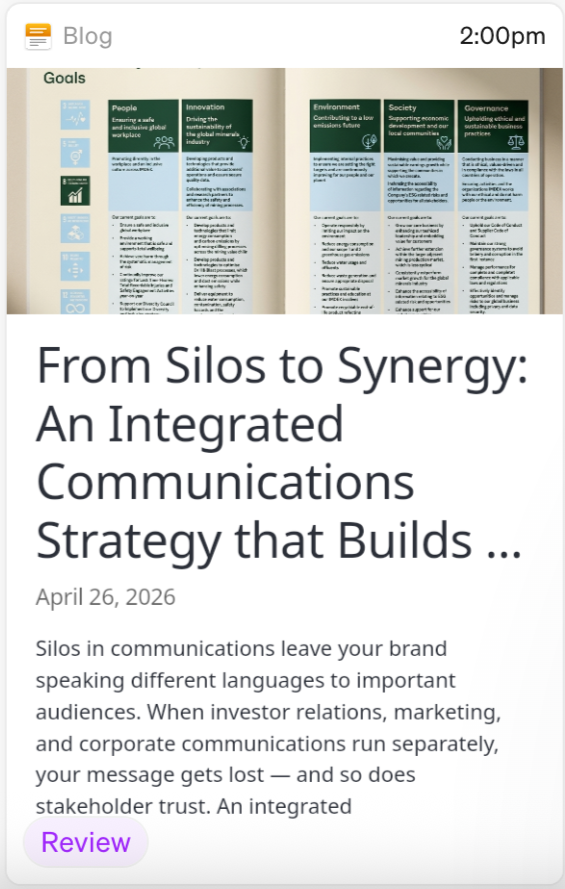
Is this an article you would genuinely want to read?
Image Generation
As part of the setup process, we uploaded our own team photography and examples of past work and here things got a bit hectic. At times, the outputs felt less like marketing assets and more like slightly unsettling stock photography from an alternate universe.
Photo Editing gone rogue
Blaze edited our faces in bizarre ways and, somehow, we all emerged looking noticeably older, slightly uncanny and with distinctly different facial features, including sharper cheekbones and longer noses (thanks for that).
It also misread our work examples when generating visuals. In one case, we uploaded an annual report cover featuring someone standing on a mountain. Blaze responded by generating an image of the report sitting on a rock with literal hikers in the background - technically connected to the original image but completely missing the design intent.

Annual Report or Hiking Guide?
Technical & Industrial Imagery
Many B2B companies rely heavily on real project photography, real team members, real sites and real operational environments. AI-generated visuals often strip away that authenticity and replace it with something that feels overly polished and generic.
The platform also regularly misunderstood technical environments and operational details when generating supporting imagery.
Examples included:
Safety gear appearing incorrectly or inconsistently
Hands and equipment becoming warped or distorted
Random visual artefacts appearing in backgrounds
Scheduling
Score: 5/5
This was one of Blaze’s strongest features.
The workflow was simple, efficient, and clearly designed for teams managing multiple platforms. Being able to generate, adapt, schedule and publish content all within one platform made the process genuinely convenient.
For businesses producing high volumes of lightweight social content, the scheduling and publishing tools could easily be the biggest selling point.
In many ways, the calendar and publishing functionality felt more mature than the content generation itself.
Our verdict
The onboarding was fast, the scheduling tools were genuinely useful and the platform made it easy to generate content quickly across multiple channels.
But for specialised and technical B2B industries, the limitations became obvious. The long-form content often lacked depth, context and originality, the image generation struggled with realism and operational accuracy and the outputs still required human editing and fact-checking.
For now, Blaze feels strongest as a workflow and content support tool, particularly, for lightweight social content, scheduling and early-stage drafts where it can genuinely save time.
